
Club Car Carryall Model Years Explained if you’ve ever tried to order a part, sell a used unit, or just figure out what you’re actually driving, you already know the problem: Club Car has used the Carryall name for over 35 years, across dozens of models, badges, and serial number formats. “Club Car Carryall model years explained” is one of the most searched questions among owners, dealers, and fleet managers for good reason the naming changes almost every few years, and a mistake here means ordering the wrong belt, battery, or body panel.
If you’re shopping rather than researching, you can skip straight to our current inventory of Club Car Carryall UTVs for sale but if you want to know exactly what generation you’re looking at first, read on.
This guide breaks down every major Club Car Carryall generation, how to tell them apart, and how to pin down the exact model year of the unit sitting in your garage or on your lot.
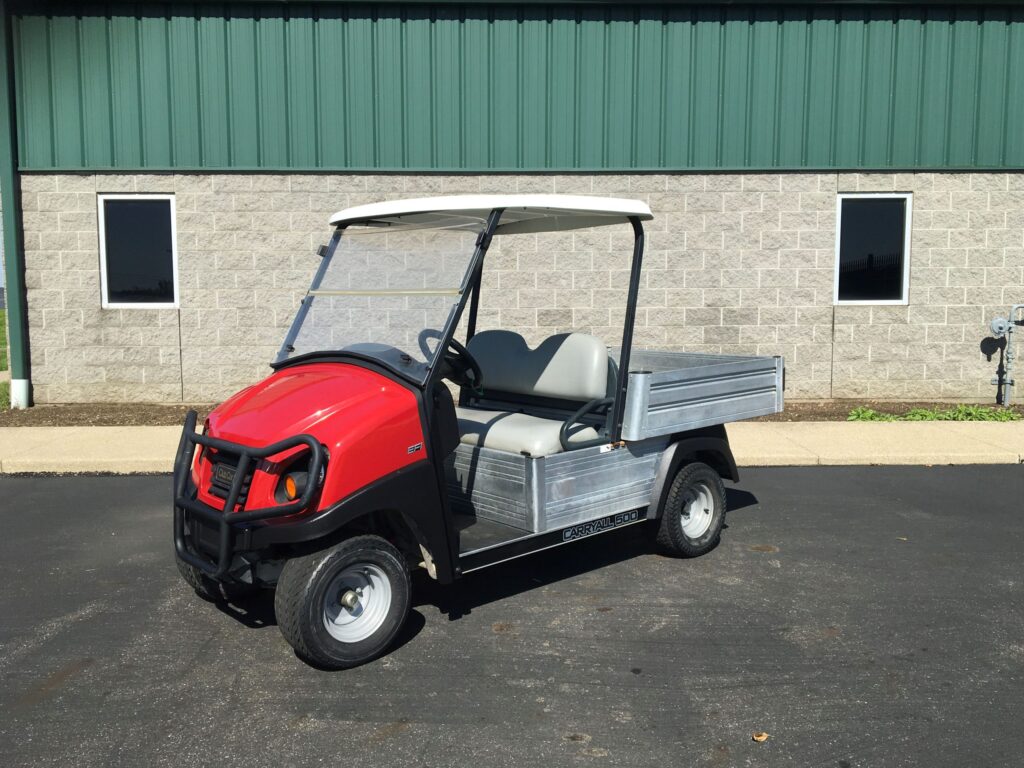
Table of Contents
- Quick Answer: Club Car Carryall Model Years at a Glance
- The Origins: Carryall I and Carryall II (Late 1980s)
- The Numbered Era: Carryall 1, 2, and 6 (1990s–2004)
- The XRT Crossover Years: Carryall 232, 252, and 295 (2004–2013)
- The Modern Numbering System: 500, 700, 1500, and 1700 (2014–2018)
- Fit-to-Task Series and Purpose-Built Configurations (2017–Present)
- Current Club Car Carryall Lineup (2019–Present)
- How to Find Your Club Car Carryall’s Model Year by Serial Number
- FAQs: Club Car Carryall Model Years
- Final Thoughts and Next Steps
Quick Answer: Club Car Carryall Model Years at a Glance
How many generations of the Club Car Carryall are there? A: Roughly five distinct eras: the original Carryall I/II (late 1980s), the numbered Carryall 1/2/6 line (1990s–early 2000s), the XRT-influenced 232/252/295 series (mid-2000s to early 2010s), the modern 500/700/1500/1700 lineup (2014 onward), and today’s Fit-to-Task and electric-focused Carryall 100/300/500/700 series.Club Car Carryall Model Years Explained
Where do I find the model year on a Club Car Carryall? A: Check the serial number decal, usually located above the passenger-side floorboard or just above and to the right of the accelerator pedal. The first two letters typically identify the model, and the numbers that follow encode the production date.
Are parts interchangeable between Carryall model years? A: Sometimes, but not always even within the same numeric name (like “Carryall 500”), body, drivetrain, and electrical components can change mid-generation. Always confirm using your Club Car Carryall serial number before ordering.
The Origins: Carryall I and Carryall II (Late 1980s)
The Club Car Carryall line launched as a heavy-duty utility vehicle built to outperform the golf-cart-based haulers of the era. The original Carryall I and Carryall II were sold in gasoline and electric versions, both featuring a rust-free aluminum pickup bed and frame a genuine innovation at the time.
Key identifiers of early Carryall models
- Rack-and-pinion steering marketed as “power steering feel”
- Largest gas engine in its class for the period (4-cycle/341cc)
- Half-ton gross payload capacity on the Carryall II
- No digital serial number decoding — identification relies mostly on physical features and dealer records
If you’re restoring or sourcing parts for a Carryall from this era, expect to work primarily with specialty resellers rather than standard parts catalogs, since these units predate most of Club Car’s modern cataloging systems. Original Carryall I/II units rarely come up for sale today, but if you’re after something with the same rugged, no-frills build quality, our inventory of used Club Car Carryall UTVs is a better starting point than chasing 1980s parts.
The Numbered Era: Carryall 1, 2, and 6 (1990s–2004)
By the 1990s, Club Car had standardized the lineup into the Carryall 1, Carryall 2, and Carryall 6, alongside Turf-specific variants for golf course and grounds maintenance use. This generation ran in production for over a decade, which is exactly why owners searching “Club Car Carryall model years explained” often land somewhere in this range the visual differences between a 1996 and a 2002 unit are subtle.Club Car Carryall Model Years Explained
What changed within this generation
- Introduction of dedicated Turf trims for low ground-pressure applications
- Broader engine options across gas and electric drivetrains
- Serial number prefixes like FG, HG, EG, PG, and RG began appearing on the identification decal
- Seat, body, and dash components from this window are commonly cross-compatible across model years, but electrical systems are not always interchangeable
The XRT Crossover Years: Carryall 232, 252, and 295 (2004–2013)
This is where things get genuinely confusing for owners. Club Car began blending its XRT off-road platform with the Carryall utility line, producing the Carryall 232, Carryall 252/Turf 252, and Carryall 295 / XRT 1550. These models share chassis architecture and many parts with their XRT-badged siblings, which trips up a lot of part searches.Club Car Carryall Model Years Explained
Notable production details
- The Carryall 295 and XRT 1550 were built on essentially the same platform, sold under different names depending on the buyer’s intended use (utility vs. off-road/sport)
- A documented 2012 recall covered fuel filler neck issues across the Carryall 232, 252, and 295/XRT 1550 lines, which is a useful reference point if you’re trying to date a unit in this range
- Serial number prefixes in this era include XL, XG, ZG, CL, CM, RF, RJ, RY, TR, and TT
If your unit has an “XRT” badge but a Carryall-style bed, you’re almost certainly looking at a vehicle from this window cross-check the serial prefix against Club Car’s official records or a trusted Carryall parts and serial number lookup resource before ordering anything electrical or drivetrain-related. This XRT-crossover era is also one of the most common finds in the used market, so if you’re browsing used Club Car Carryall units for sale, don’t be surprised to see a mix of Carryall and XRT badging on very similar vehicles.Club Car Carryall Model Years Explained
The Modern Numbering System: 500, 700, 1500, and 1700 (2014–2018)
Around 2014, Club Car moved to the numbering convention most owners recognize today: Carryall 500, 700, 1500, and 1700, roughly indicating payload and platform size (with 1500/1700 representing the larger 4×4-capable utility platform, available in gas or diesel).Club Car Carryall Model Years Explained
Distinguishing features
- Carryall 500/700: Mid-size 2WD utility platform, gas or electric, widely used in resort, hospitality, and light industrial fleets
- Carryall 1500/1700: Larger 4×4 platform available in gas or diesel, aimed at heavier-duty grounds and agricultural work
- Dash, seating, and instrument panel updates distinguish early units (2014–2018) from the current generation
- This generation is well documented in parts catalogs, making it one of the easier eras to source components for
This is also one of the most popular generations on the resale market reliable, well-supported, and available in configurations for almost any job. If you’re in the market for one, check our current listings of Club Car Carryall 500, 700, 1500, and 1700 models for sale to compare condition, drivetrain, and pricing side by side.
Fit-to-Task Series and Purpose-Built Configurations (2017–Present)
In 2017, Club Car introduced the Fit-to-Task Series pre-configured versions of the Carryall 500 and Carryall 700 built for specific jobs like food service, housekeeping, facilities engineering, and ambulance/transport duty. Rather than buying a base unit and bolting on aftermarket accessories, buyers could order a Carryall already equipped for the task at hand, with rustproof aluminum frames and application-specific attachments built in from the factory.Club Car Carryall Model Years Explained
This matters for model-year identification because two units with the same base name and same production year can look completely different depending on which Fit-to-Task configuration they left the factory as.
Current Club Car Carryall Lineup (2019–Present)
The current generation includes the Carryall 100, Carryall 300, Carryall 500, Carryall 700, Carryall 1500, and Carryall 1700, spanning personal-use compact utility vehicles up through heavy-duty 4×4 diesel platforms.
What’s new in this generation
- Expanded electric drivetrain options, including lithium battery configurations on several trims
- Turf-specific trims (Carryall 300 Turf, Carryall 700 Turf) continue to serve golf course and grounds crews
- Improved suspension and payload capacity across the 1500/1700 platform
- More granular model-year-specific parts availability, since these units are still in active production and well supported by dealers
Because this lineup is current, it’s also the easiest to verify most parts retailers and Club Car dealers can pull exact specs the moment you provide a serial number. Shopping for one of these newer units? Our full selection of current-generation Club Car Carryall UTVs for sale includes verified model years and specs for each listing, so you’re never guessing what you’re buying.Club Car Carryall Model Years Explained
How to Find Your Club Car Carryall’s Model Year by Serial Number
Regardless of era, the process for decoding your Club Car Carryall’s model year follows a similar pattern:
- Locate the identification decal. On most Carryall models, it’s above the passenger-side floorboard or near the accelerator pedal.
- Read the model prefix. The first two letters usually correspond to the specific model and drivetrain (gas, electric, diesel).
- Read the numeric sequence. The digits that follow encode the production date, though the exact format has changed across eras — older units use a straightforward numeric run, while newer ones separate the sequence with a dash indicating month/year of production.
- Cross-reference with official records. If you’re unsure, Club Car dealers and parts specialists can match a serial number to an exact build date and specification sheet.Club Car Carryall Model Years Explained
If you’re not confident reading your own decal, our Club Car Carryall serial number lookup tool can match your unit to its exact model year and factory specs in seconds a much faster route than guessing based on body style alone.
FAQs: Club Car Carryall Model Years
What is the oldest Club Car Carryall model?
The original Carryall I and Carryall II, introduced in the late 1980s, were the first vehicles to carry the Carryall name, offered in both gasoline and electric versions.
How do I know if my Club Car Carryall is gas, electric, or diesel?
Check the serial number prefix on the identification decal different letter combinations correspond to different drivetrains, even within the same model number (for example, Carryall 1700 Gas vs. Carryall 1700 Diesel).
Are Club Car Carryall parts interchangeable across model years?
Not always. Even units sharing the same model number, like “Carryall 700,” can have different dash panels, wiring, or suspension components depending on the exact production year. Always verify with your serial number before ordering.
What’s the difference between Carryall 1500 and Carryall 1700?
Both are built on Club Car’s larger 4×4 utility platform, but the 1700 typically offers a higher payload and towing capacity, along with diesel engine availability, making it the choice for heavier-duty commercial and agricultural work.
Why did Club Car change its naming system so often?
Club Car has periodically restructured its lineup to reflect platform changes, payload classes, and crossover technology from its XRT off-road line. Each renaming generally corresponds to a genuine mechanical or chassis update, not just a marketing refresh.
Where can I check for open recalls on my Carryall?
Recalls are typically issued through the U.S. Consumer Product Safety Commission and Club Car directly. Have your serial number ready, since recalls are almost always tied to specific serial number ranges rather than entire model years.
Is a used Club Car Carryall from the 2000s still worth buying?
It depends on maintenance history and intended use. Units from the Carryall 232/252/295 era are still widely supported for parts, but confirm serial-number-specific compatibility before buying, especially for electrical and fuel system components.
Final Thoughts and Next Steps
Understanding Club Car Carryall model years isn’t just trivia it directly affects which parts fit, what your resale value looks like, and whether your unit is covered under a past recall. Whenever you’re in doubt, the serial number decal is your single most reliable source of truth, more dependable than body style, badge, or even paint scheme.
Ready to identify your exact model year or find your next unit?
- Browse our full inventory of Club Car Carryall UTVs for sale, organized by model and drivetrain so you can compare generations side by side
- Use our Club Car Carryall parts finder by model year to match components to your exact serial number
- Get in touch through our Club Car Carryall service and support page if you need help decoding an older or non-standard serial number
Knowing your generation is the first step getting the right unit or the right parts the first time is what actually saves you money.
(Note: the parts finder and support page links are still placeholders swap in your real URLs before publishing. The Carryall UTV listings link above is live.)